Russia
The Siberian Giant & The Arctic Frontier
Director's technical brief
"The pivot to Asia is no longer a strategic choice but a structural reality for Russian energy. Infrastructure constraints on the 'Power of Siberia' and Arctic technical hurdles are the primary bottlenecks we model for 2026 production forecasts."
Key Takeaways
- •World's second-largest producer of crude oil and a leading gas exporter.
- •The West Siberian Basin is one of the world's most productive hydrocarbon provinces.
- •Strategic focus on the 'Power of Siberia' pipeline to China.
- •Yamal LNG is a pioneering project in the ultra-harsh Arctic conditions.
Energy Lifecycle Architecture
upstream
West Siberian Basin / Arctic Drilling
midstream
Transneft Pipeline Infrastructure
downstream
Yamal LNG / Arctic Hubs
market
Power of Siberia & Asian Markets
Basin Maturity & Reserve Outlook
Detailed basin analytics for this region are currently being synthesized by the research desk.
10-YEAR PRODUCTION TREND
Overview
Russia is a global energy titan. With reserves that span eleven time zones and reach deep into the Arctic Circle, Russia is one of the few nations capable of single-handedly shifting global energy markets. In 2024, Russia produces approximately 9.5-10.0 mb/d of crude oil and is the world's second-largest exporter of natural gas. Its energy sector is the lifeblood of the Russian economy, accounting for over 40% of federal budget revenues and serving as the primary tool for the state's geopolitical strategy.
The Russian energy story is defined by its massive, conventional reservoirs and its unparalleled ability to operate in ultra-harsh environments. From the marshy taiga of Western Siberia to the frozen wastes of the Yamal Peninsula, Russia has built a sophisticated industrial ecosystem that includes the world's largest pipeline network and a rapidly expanding fleet of Arctic LNG tankers.
The West Siberian Basin: The Siberian Foundation
The West Siberian Basin is the heart of the Russian industry. Covering over 2 million square kilometers, it is one of the world's most significant sedimentary basins. Since its discovery in the 1960s, it has been the primary source of Russia's oil and gas wealth.
Geology of the Samotlor Field
The Samotlor field, located in the Tyumen region, is the giant of West Siberia. Its geology consists of multiple layers of Cretaceous-age sandstone and Jurassic horizons, providing a stable and high-volume production base for decades.
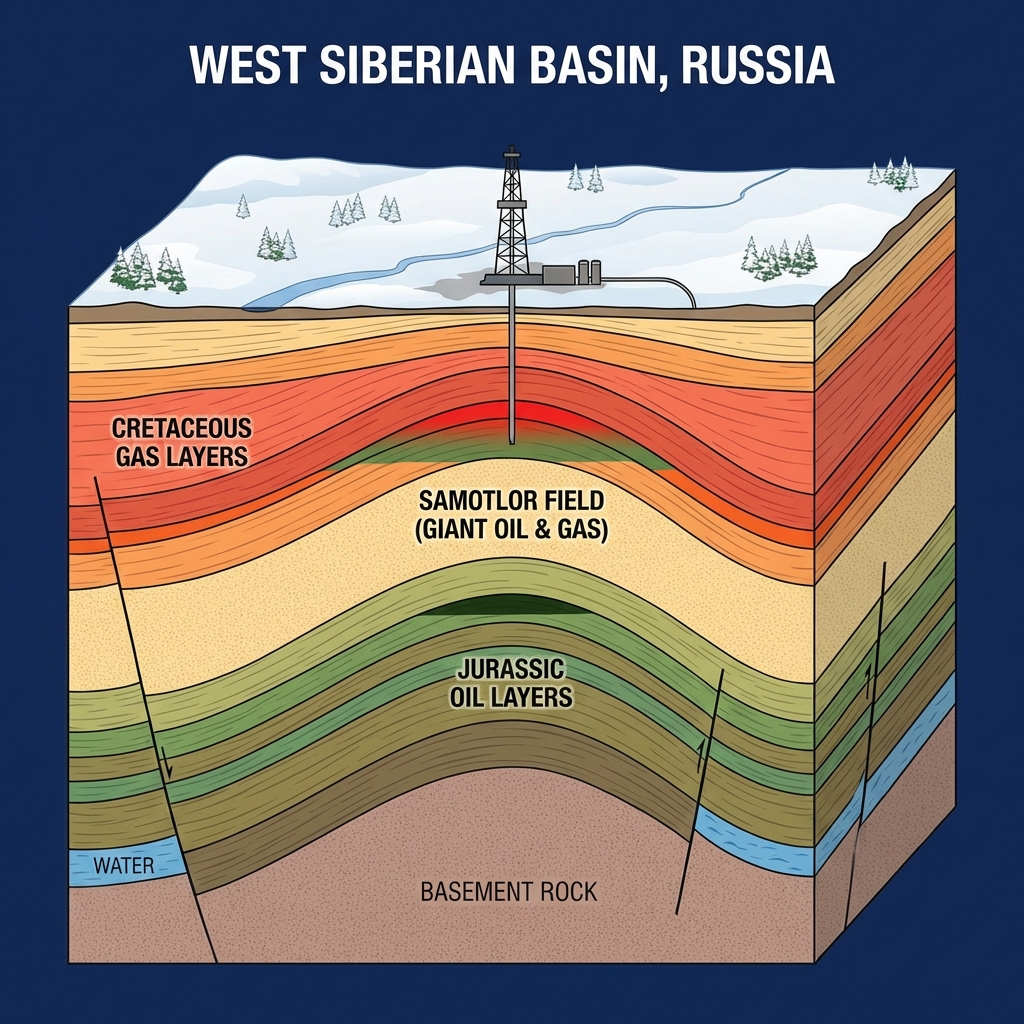 Figure 1: Technical geological diagram of the West Siberian Basin, showing the layered sedimentary structure of the giant Samotlor field.
| Basin / Region | Primary Resource | Major Field(s) | Status |
|---|---|---|---|
| West Siberia | Oil and Gas | Samotlor, Urengoy | Mature production core |
| Yamal-Nenets | Natural Gas | Bovanenkovo | Future growth pillar |
| Ural-Volga | Oil | Romashkino | Traditional legacy basin |
| Sakhalin | Oil and Gas (Offshore) | Sakhalin-1, Sakhalin-2 | Strategic Pacific export hub |
| Vankor Cluster | Oil | Vankor | Key source for Asian exports |
Arctic LNG: The Yamal Revolution
As its mature fields in Western Siberia begin an inevitable decline, Russia has turned its gaze to the north. The Yamal LNG project, led by Novatek in partnership with TotalEnergies and CNPC, is a historic engineering achievement. Located on the edge of the Kara Sea, it produces LNG in extreme sub-zero temperatures using air-cooled technology—a method that is actually more efficient in the cold Arctic air.
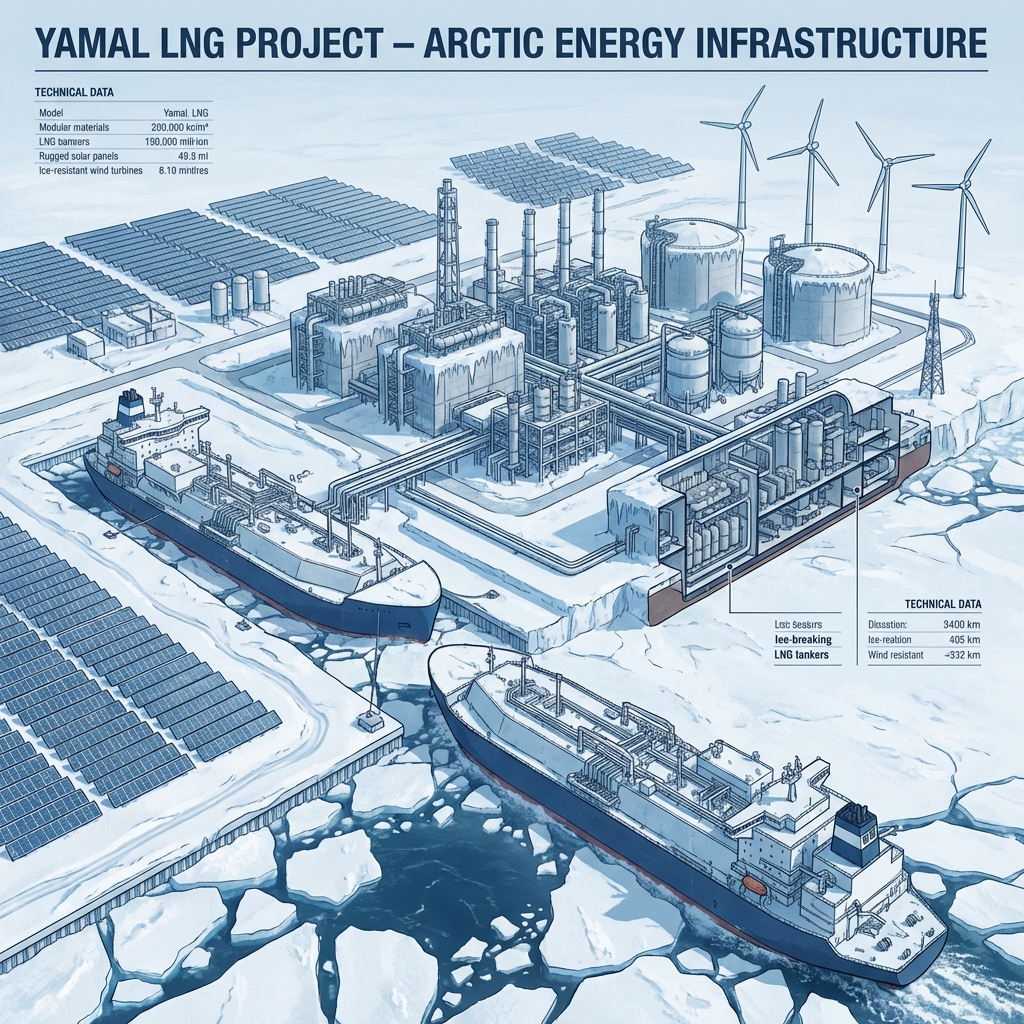 Figure 2: Technical illustration of the Yamal LNG project, showing the massive Arctic processing facility and ice-breaking LNG tankers.
The success of Yamal has led to the development of Arctic LNG 2 and the creation of the Northern Sea Route (NSR)—a shipping corridor that allows Russian gas to reach Asian markets in half the time of traditional southern routes via the Suez Canal.
Infrastructure: The Arteries of Eurasia
Russia operates the world's most extensive pipeline network, linking the depths of Siberia to consumers in Europe and, increasingly, Asia.
The Druzhba and Power of Siberia
The Druzhba pipeline is the world's longest oil pipeline, historically serving as the primary energy link between Russia and Central Europe. However, recent years have seen a strategic "Pivot to the East," epitomized by the Power of Siberia gas pipeline to China.
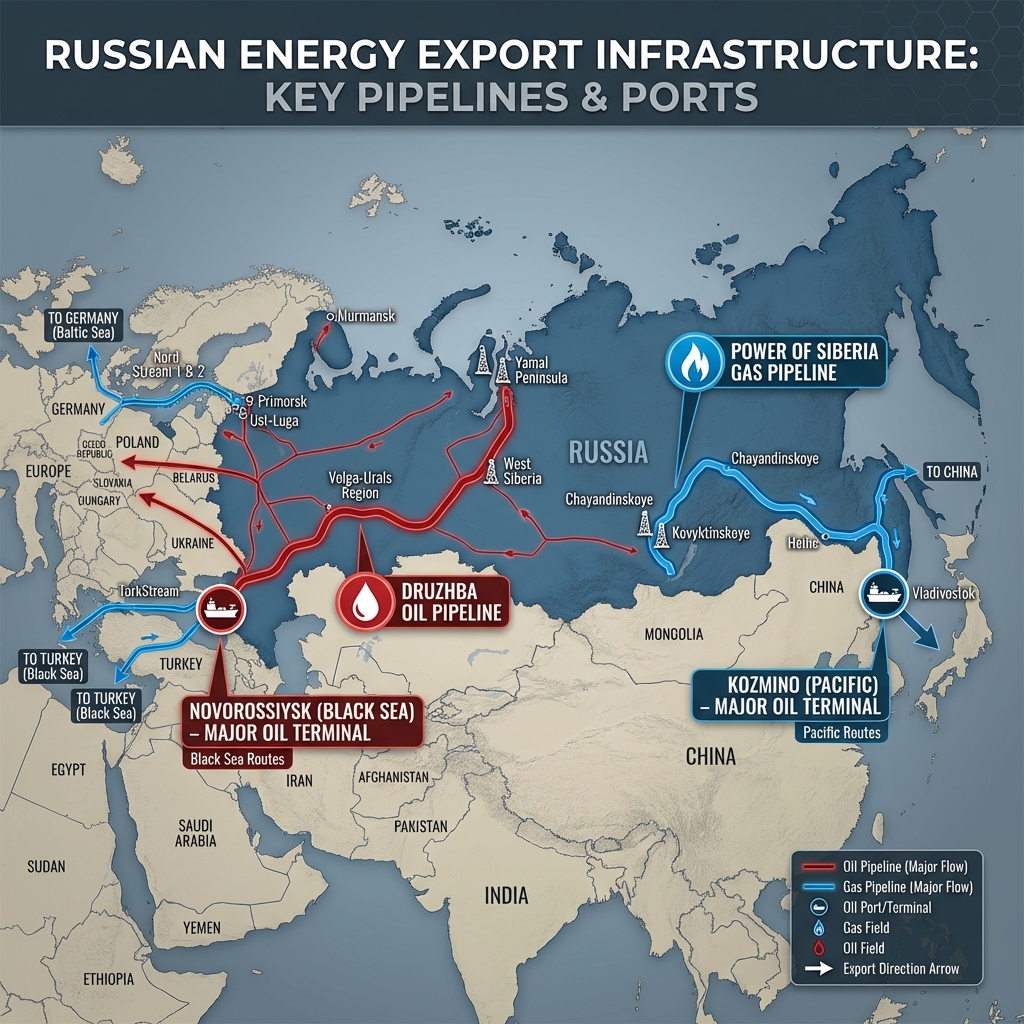 Figure 3: Infographic map of the Russian energy export infrastructure, highlighting the strategic pipelines to both Europe and China.
Discovery History: From Imperial Baku to the Soviet Boom
Russia's oil history began in the 1870s in Baku (now Azerbaijan), which was then part of the Russian Empire. The discovery of the Ural-Volga fields in the 1930s (the "Second Baku") saved the Soviet Union during WWII. But the real transformation was the 1960s discovery of Western Siberia, which turned the USSR into a global energy superpower. The post-Soviet era was defined by the transition from state-run ministries to giant corporate entities like Rosneft and Gazprom, which today operate as the commercial and political arms of the Russian state.
Technical Spotlight: Arctic Well Engineering & Permafrost Stabilization
Extracting oil and gas in the Russian Arctic requires engineering solutions that are not found anywhere else. The primary technical challenge is Permafrost—ground that remains frozen year-round.
Thermopile Stabilization
When a wellbore carries hot hydrocarbons from deep underground, it can melt the surrounding permafrost, leading to structural instability and environmental damage. Russian engineers at Yamal and Vankor use a "Thermopile" system—passive cooling pipes filled with refrigerant that draw heat away from the wellhead and dissipate it into the cold Arctic air, keeping the ground frozen and stable.
Arctic Metallurgy & Ice-Resistant Design
Steel used in Arctic drilling must be specially formulated to prevent brittle fracture at temperatures as low as -60°C. Furthermore, offshore platforms like Prirazlomnaya are built with reinforced hulls and "ice-deflectors" to withstand the massive kinetic force of drifting ice floes, which can exert millions of tons of pressure.
Case Study: The Druzhba Contamination Crisis
In April 2019, the Russian energy sector faced an unprecedented technical and commercial crisis. High levels of organic chlorides—chemicals used to increase refinery output but which can damage equipment—were detected in the Druzhba pipeline, the massive trunk line supplying Europe.
The Impact
The contamination forced the shutdown of the pipeline for weeks, impacting refineries in Germany, Poland, and the Czech Republic. It highlighted the vulnerability of large-scale interconnected infrastructure to quality control failures.
The Technical Cleanup
The remediation involved a massive technical operation to flush the contaminated crude (over 5 million tons) into temporary storage and replace it with clean supply. Russia subsequently implemented a much more rigorous, automated quality-monitoring system at every injection point in the Transneft network, ensuring that such a breach of protocol can be detected in real-time before entering the main export lines.
The Druzhba Pipeline: Engineering the World's Longest Oil Trunkline
The Druzhba (Friendship) Pipeline is a monumental achievement of Soviet-era engineering and remains the backbone of Russia's oil export infrastructure to Europe. Stretching over 4,000 kilometers, it is the longest pipeline system in the world.
System Architecture
The Druzhba begins in the central Russian city of Almetyevsk, where it collects crude from the Ural-Volga and Siberian regions. It then splits in Belarus into two main branches: the Northern Druzhba (serving Poland and Germany) and the Southern Druzhba (serving Hungary, Slovakia, and the Czech Republic). The technical management of this system requires a sophisticated network of over 40 pumping stations and massive storage hubs to maintain constant pressure and flow across the vast European plain.
Operational Resilience
Despite the age of the system (construction began in the 1960s), the Druzhba has demonstrated remarkable technical resilience. It is managed by Transneft, the world's largest pipeline operator, which uses advanced in-line inspection tools (known as "smart pigs") to detect corrosion or structural defects from the inside without stopping the flow of oil. The transition of this system to handle the newer "ESPO-grade" crude and its role in the shifting European energy landscape remains one of the most critical technical challenges for Russian energy planners.
Technical Data: Major Russian Oil & Gas Fields
Russia's production base is a mix of legacy Soviet-era giants and new high-tech Arctic clusters. The technical characteristics of these fields define the complexity of the Russian export mix.
| Field Name | Region | Resource Type | Discovery | Production Status | Primary Operator |
|---|---|---|---|---|---|
| Samotlor | West Siberia | Crude Oil | 1965 | Mature (EOR hub) | Rosneft |
| Urengoy | West Siberia | Natural Gas | 1966 | Mega-Giant (Gas) | Gazprom |
| Romashkino | Ural-Volga | Crude Oil | 1948 | Heritage (High Water Cut) | Tatneft |
| Bovanenkovo | Yamal | Natural Gas | 1971 | Growth (Arctic Hub) | Gazprom |
| Vankor | East Siberia | Crude Oil | 1988 | Pivot (Asian Export) | Rosneft |
| Sakhalin-2 | Far East | LNG / Oil | 1986 | Offshore / Strategic | Sakhalin Energy |
The Challenge of Maturity and Water Cut
In mature basins like the Ural-Volga, the "Water Cut"—the percentage of water produced alongside oil—can exceed 90%. Maintaining production in these areas requires massive technical investment in high-capacity pumps and water-separation facilities. Conversely, the new fields in East Siberia (Vankor) and the Arctic (Yamal) have very low water cuts but face the immense logistical challenge of transporting resources across thousands of kilometers of wilderness where no infrastructure previously existed.
Regulatory & Tax: The Mineral Extraction Tax (MET) Shield
Russia utilizes a unique "Tax Maneuver" designed to protect the domestic economy while maximizing revenue from high global oil prices.
The MET and Export Duty
The primary fiscal tools are the Mineral Extraction Tax (MET) and the Export Duty. These taxes are indexed to the price of Urals crude; when prices are high, the state captures a larger percentage of the revenue (up to 80-90% of the marginal barrel). This system ensures that the federal budget remains stable even if production costs vary between the mature West Siberian fields and the new high-tech Arctic projects.
The Tax Maneuver
Since 2019, Russia has been phasing out export duties in favor of higher MET rates. This "Tax Maneuver" is designed to encourage domestic refining and reduce the indirect subsidies previously given to neighboring nations. The technical complexity of calculating these dynamic tax rates across different field types (e.g., shale vs. conventional) is managed through a sophisticated digital reporting system that links field output directly to the federal treasury.
Geopolitical Strategy: Energy as Statecraft
For Russia, energy is more than a commodity; it is a fundamental tool of statecraft. By controlling the flow of gas to Europe and the flow of oil to Asia, Russia maintains significant influence over global affairs.
- The Asian Pivot: As relations with the West have soured, Russia has accelerated its infrastructure build-out to China (Power of Siberia 2) and India (via the Far East ports).
- OPEC+ Partnership: The alliance between Russia and Saudi Arabia is the most powerful force in the global oil market, allowing the "Big Two" to manage supply and price with unprecedented precision.
Energy Transition: Hydrogen and Arctic Wind
While Russia remains a hydrocarbon giant, it is exploring the "New Energy" frontier through its Arctic expertise.
- Blue Hydrogen: Russia aims to use its vast gas reserves to produce blue hydrogen for export.
- Arctic Wind: The Kola Peninsula and Yamal have some of the highest wind potentials in the world, with projects being developed to power the new Arctic LNG clusters.
Future Outlook: The Resilience of the Giant
The future of Russian energy depends on its ability to navigate technological sanctions and continue its shift toward Asian markets. By leveraging its low production costs and massive Arctic resource base, Russia aims to remain the indispensable energy provider for the emerging economies of the 21st century. As the world transitions, the "Siberian Giant" remains the essential foundation of the global energy balance.

"PetroEyes Research is the site-level attribution used for public data summaries and explainers. It does not represent a licensed financial adviser or a fictional individual. Articles remain outside public discovery until their named sources, dates, and material claims complete editorial review."