Saudi Arabia
The Central Bank of Oil & The Gateway to Vision 2030
Director's technical brief
"As the world's 'Swing Producer,' Saudi Arabia's spare capacity is the ultimate stabilizer. We track the development of the Marjan and Berri fields as technical indicators of the Kingdom's future production ceiling."
Key Takeaways
- •Largest exporter of crude oil in the world.
- •Possesses approximately 17% of the world's proven petroleum reserves.
- •Saudi Aramco is the world's most profitable and technologically advanced oil company.
- •The Ghawar Field is the largest conventional onshore oil field on Earth.
Energy Lifecycle Architecture
upstream
Ghawar Conventional Extraction
midstream
East-West Pipeline Network
downstream
Ras Tanura Mega-Refining
market
Red Sea & Gulf Global Terminals
Basin Maturity & Reserve Outlook
Detailed basin analytics for this region are currently being synthesized by the research desk.
10-YEAR PRODUCTION TREND
Overview
Saudi Arabia is the indispensable anchor of the global energy system. Holding the position of the world's "Swing Producer," the Kingdom possesses a unique ability to rapidly increase or decrease production to stabilize global prices—a role known as the "Energy Central Bank." In 2024, Saudi Arabia maintains a Maximum Sustainable Capacity (MSC) of approximately 12.0 mb/d, though it often produces between 9.0 and 10.5 mb/d to adhere to OPEC+ stability agreements.
The Saudi energy story is one of unprecedented scale and long-term strategic planning. Through its national champion, Saudi Aramco, the Kingdom manages not just a resource, but a global value chain that spans from the desert sands of the Empty Quarter to high-tech refining and chemical complexes in Asia, Europe, and the Americas.
The Ghawar Field: A Geological Phenomenon
At the heart of the Saudi miracle is the Ghawar Field. Discovered in 1948, Ghawar is a geological wonder, stretching 174 miles long and 16 miles wide. It alone has produced over 60% of the Kingdom's total cumulative oil output.
The Arab-D Reservoir
The secret to Ghawar's longevity and productivity lies in the Arab-D formation—a Jurassic-age carbonate reservoir. The interval is characterized by exceptional porosity and permeability, allowing oil to flow with minimal resistance.
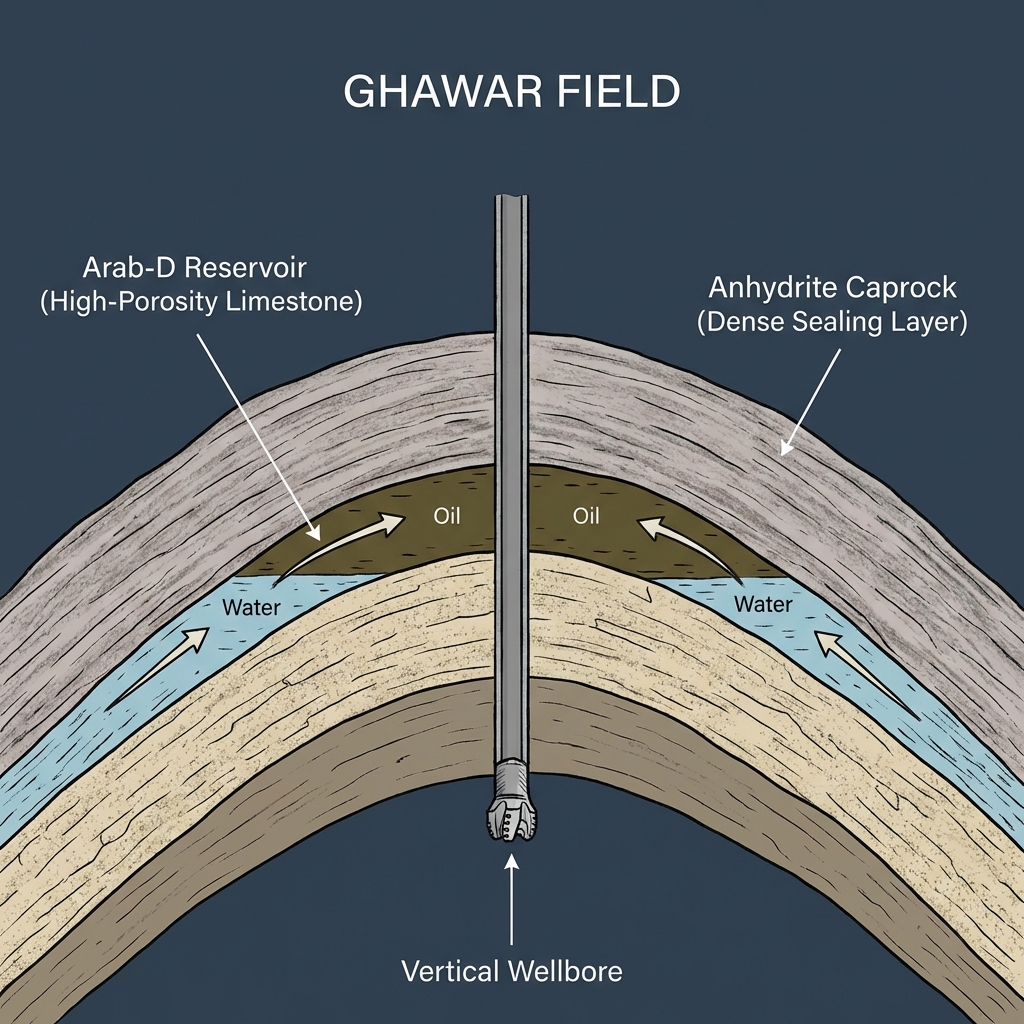 Figure 1: Technical diagram of the Ghawar field's Arab-D reservoir, showing the high-porosity limestone trapped beneath a dense anhydrite caprock.
| Field Name | Type | Key Characteristics | Status |
|---|---|---|---|
| Ghawar | Onshore | World's largest oil field | Production Backbone |
| Safaniyah | Offshore | World's largest offshore field | Heavy crude hub |
| Khurais | Onshore | Intelligent field / High automation | Strategic expansion hub |
| Shaybah | Remote Onshore | High-quality extra-light crude | Logistics miracle in the Rub' al Khali |
Saudi Aramco: The Global Value Chain
Saudi Aramco is more than an oil company; it is a global industrial ecosystem. The company operates the entire spectrum of the energy business, from upstream exploration to downstream refining, retail, and petrochemicals.
The Master Gas System (MGS)
A critical but often overlooked component of Saudi infrastructure is the Master Gas System (MGS). Built in the 1970s, the MGS captures associated gas that was previously flared, using it to power the nation's industry and feed its massive petrochemical sector at cities like Jubail and Yanbu.
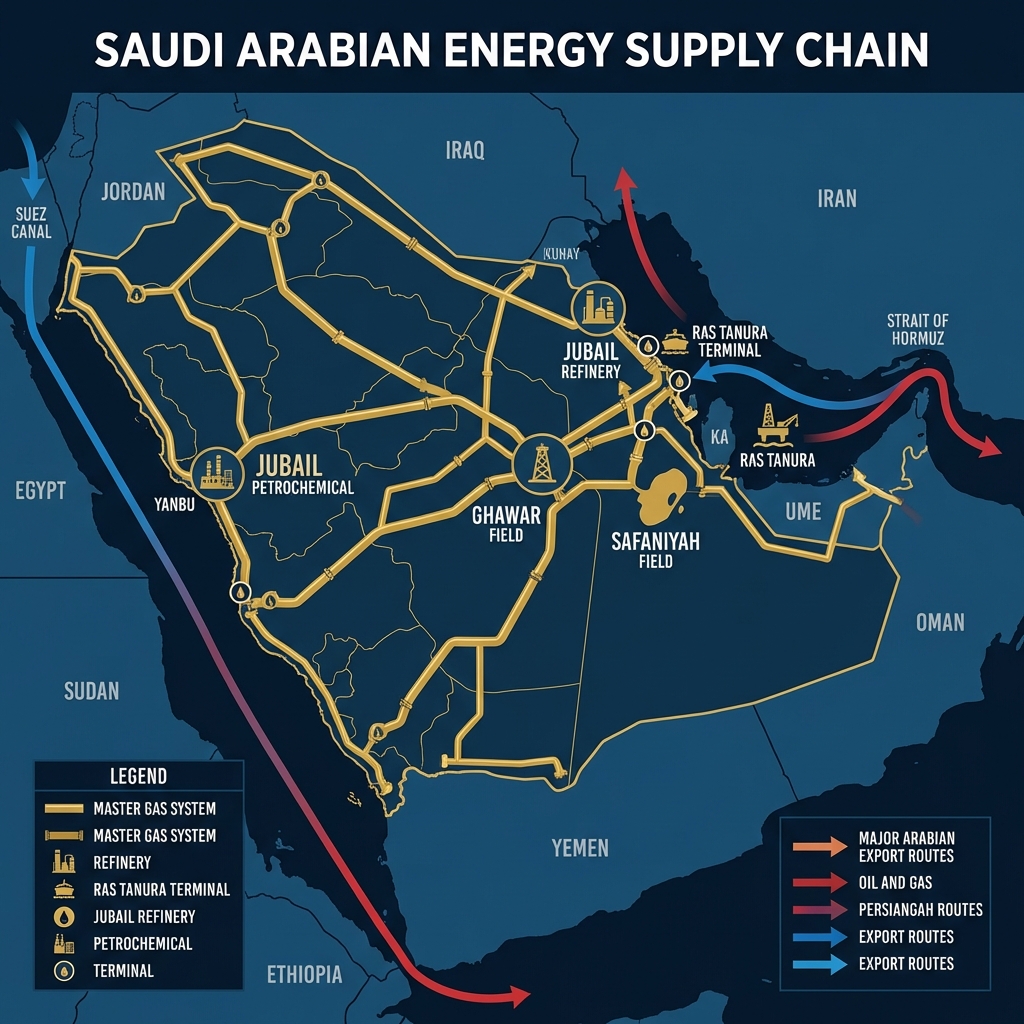 Figure 2: Infographic map of the Saudi Arabian energy supply chain, highlighting the Master Gas System and the strategic refining hubs of Jubail and Yanbu.
Discovery History: From Dammam No. 7 to Global Hub
The modern history of Saudi Arabia began in 1933, when King Abdulaziz Al Saud granted a concession to Standard Oil of California (Socal). After five years of failure, the "Prosperity Well"—Dammam No. 7—struck oil in 1938 at a depth of 4,727 feet. This moment transformed a desert kingdom into the pivot point of the global economy.
Following the full nationalization of Aramco in 1980, the Kingdom prioritized technical excellence and long-term reservoir management. The landmark 2019 IPO of Saudi Aramco—the largest in history—marked a new era of transparency and global market integration, signaling the Kingdom's commitment to modernizing its most valuable asset.
Technical Spotlight: Cybersecurity in Critical Energy Infrastructure
As the world's most important energy hub, Saudi Arabia's infrastructure is a prime target for high-level cyber threats. Saudi Aramco has pioneered some of the world's most robust industrial cybersecurity frameworks to protect its vast operations.
The 4th Industrial Revolution (4IR) Center
In Dhahran, Aramco operates a state-of-the-art 4IR Center, which uses AI and machine learning to monitor millions of data points across the Kingdom's oil and gas network. This system doesn't just track production; it identifies anomalies in network traffic that could indicate an attempted breach of the Industrial Control Systems (ICS) or SCADA networks that manage the flow of oil.
Defense in Depth
The Kingdom utilizes a "Defense in Depth" strategy, isolating critical safety systems from the public internet and using unidirectional "security gateways" to ensure that data can flow out for monitoring but malicious commands cannot flow in. This technical infrastructure is vital for maintaining the MSC (Maximum Sustainable Capacity) that the global economy relies on.
Case Study: The 2019 Abqaiq-Khurais Attack & Supply Resilience
On September 14, 2019, the global energy market faced its greatest test of resilience. A coordinated drone and cruise missile attack struck the Abqaiq processing facility and the Khurais oil field, temporarily knocking out 5.7 mb/d—roughly 5% of global supply.
The Immediate Response
Despite the massive scale of the physical damage, the global price shock was relatively short-lived. This was due to Saudi Arabia's strategic foresight in maintaining a massive Strategic Petroleum Reserve and its ability to utilize its redundant pipeline networks (like the East-West Pipeline) to bypass the damaged facilities.
The Speed of Recovery
The technical achievement of the recovery was unprecedented. Aramco engineers worked around the clock, utilizing their extensive inventory of spare parts and global supply chain partnerships to restore 100% of production in less than three weeks. This event proved that the Kingdom's "Spare Capacity" is not just about having oil in the ground, but about having the technical and logistical resilience to restore supply after a major kinetic disruption.
The Master Gas System (MGS): Engineering the Kingdom's Industrial Future
While oil is the Kingdom's primary export, the Master Gas System (MGS) is the backbone of its domestic economy. Launched in 1975, the MGS was one of the largest industrial projects ever undertaken, designed to capture the associated gas that was previously flared (burned off) during oil production.
Capturing Wasted Value
Prior to the MGS, the billions of cubic feet of gas produced alongside oil were considered a nuisance and wasted. The MGS created a Kingdom-wide network of processing plants and pipelines that treat this gas, removing impurities like sulfur and natural gas liquids (NGLs). This gas is then used to power the nation's electricity grid and provide the essential feedstock for the world-leading petrochemical industry at Jubail and Yanbu.
Strategic Expansion
In 2024, the Kingdom is undergoing the MGS-3 expansion, which will increase the system's capacity to over 12.5 Bcf/d. This expansion is critical for the "Gas-to-Power" initiative, which aims to replace the burning of crude oil for electricity generation with cleaner-burning natural gas, freeing up an additional 1 million barrels of high-value crude for export every day. The technical complexity of managing this massive, pressurized gas network across the vast Saudi desert is a testament to the Kingdom's engineering prowess.
Technical Data: Major Saudi Oil Fields & Reservoir Characteristics
The longevity of Saudi Arabia's production is due to the scale and quality of its giant fields. Each field is managed with long-term reservoir sustainability as the primary goal, utilizing "intelligent" technology to monitor flow and pressure.
| Field Name | Type | Discovery | Primary Reservoir | API Gravity | Significance |
|---|---|---|---|---|---|
| Ghawar | Onshore | 1948 | Arab-D (Limestone) | 32° - 34° | Largest onshore field globally |
| Safaniyah | Offshore | 1951 | Khafji (Sandstone) | 27° | Largest offshore field globally |
| Khurais | Onshore | 1957 | Arab-D | 33° - 36° | High-tech automation flagship |
| Shaybah | Onshore | 1968 | Shu'aiba (Carbonate) | 42° | High-quality extra-light crude |
| Manifa | Offshore | 1957 | Arab-D | 28° | Built via man-made causeways |
| Zuluf | Offshore | 1965 | Khafji / Safaniyah | 31° | Major expansion target |
Strategy of Reservoir Management
The Kingdom avoids "over-producing" fields for short-term gain. Instead, it utilizes Peripheral Water Injection to maintain pressure and high recovery factors. In fields like Manifa, Aramco built a series of man-made islands and causeways to access the reservoir while protecting the fragile marine environment, demonstrating the intersection of mega-scale engineering and ecological stewardship.
Regulatory & Governance: The Custodian of the Resource
The governance of the Saudi oil sector is centralized, strategic, and deeply integrated with the national interest.
The Ministry of Energy
All hydrocarbon resources are owned by the State. The Ministry of Energy, led by Prince Abdulaziz bin Salman, sets the Kingdom's overall energy strategy, including production targets and Maximum Sustainable Capacity (MSC) levels. This centralization allows the Kingdom to act decisively in global markets, coordinating with OPEC+ partners to ensure price stability.
The Aramco Concession
Saudi Aramco operates under a long-term concession agreement with the State, which was recently renewed and modernized ahead of the 2019 IPO. The company pays a combination of royalties, taxes, and dividends to the government. This framework ensures that while Aramco operates with the technical and commercial efficiency of a private major, its strategic objectives remain perfectly aligned with the Kingdom's long-term fiscal and geopolitical goals.
Geopolitical Strategy: Maximum Sustainable Capacity
Saudi Arabia's geopolitical power is derived from its Maximum Sustainable Capacity (MSC). By maintaining a buffer of spare capacity, the Kingdom acts as the world's primary defense against supply shocks (such as wars or natural disasters). This "Spare Capacity" is the ultimate geopolitical tool, ensuring that Saudi Arabia remains the most important voice in the OPEC+ alliance and a critical partner for every major global economy.
Vision 2030: Beyond the Barrel
Under the leadership of Crown Prince Mohammed bin Salman, the Kingdom has launched Vision 2030—a massive economic diversification program aimed at reducing reliance on oil.
- NEOM & Green Hydrogen: The HEOM project in the northwest will host the world's largest green hydrogen plant, leveraging the region's unmatched solar and wind potential.
- Sustainability: Saudi Arabia has committed to a "Circular Carbon Economy" and aims to reach Net Zero by 2060.
- Liquids-to-Chemicals: Aramco is pivoting from selling crude to selling high-value chemicals, integrating refining and chemicals at an unprecedented scale.
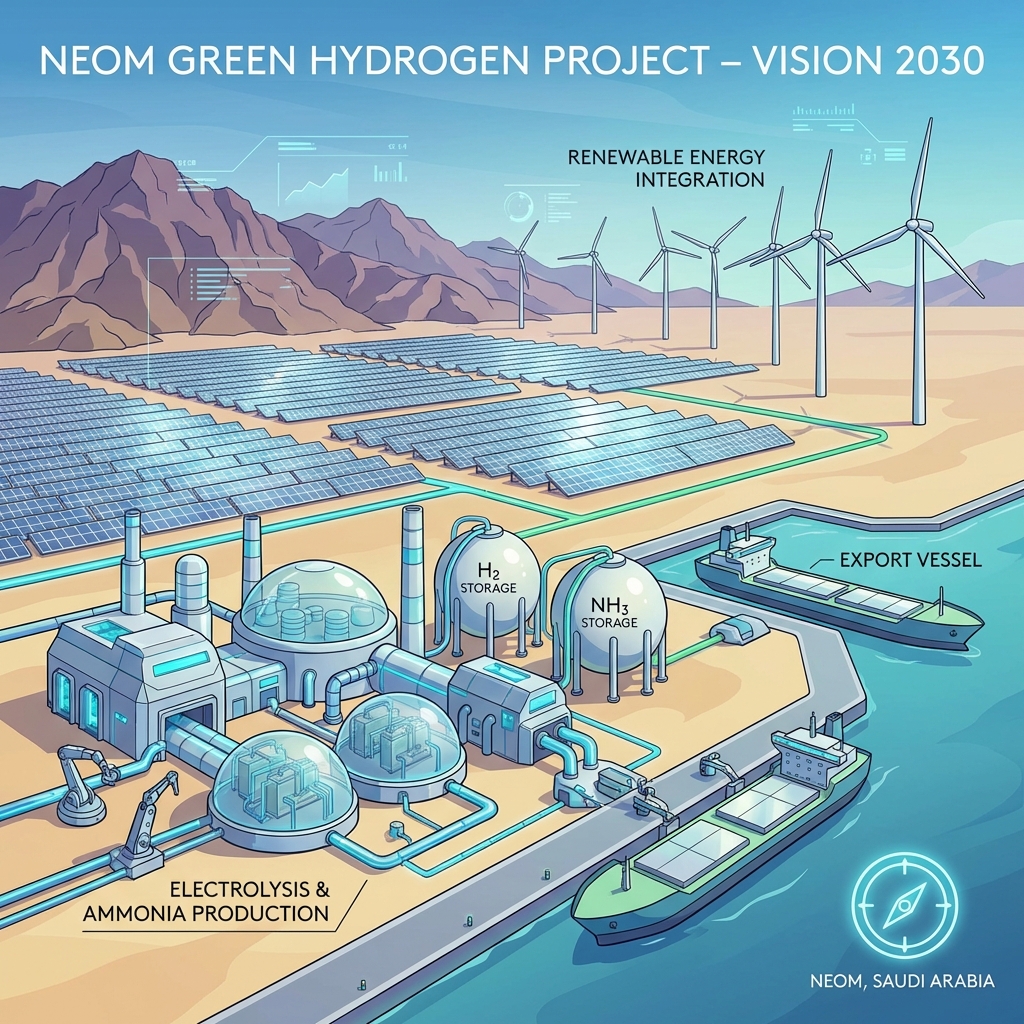 Figure 3: Futuristic illustration of the NEOM Green Hydrogen project, a cornerstone of Vision 2030's commitment to sustainable energy leadership.
Future Outlook: The Hub of Global Trade
The future of Saudi Arabia lies in being the Multi-Energy Hub of the 21st century. By producing the "last, cheapest, and cleanest barrel" while simultaneously leading in green hydrogen and solar energy, the Kingdom aims to remain the center of gravity for the global energy trade long into the post-carbon future. As the world transitions, the gateway provided by Saudi Arabia remains the most critical path to global energy stability.

"PetroEyes Research is the site-level attribution used for public data summaries and explainers. It does not represent a licensed financial adviser or a fictional individual. Articles remain outside public discovery until their named sources, dates, and material claims complete editorial review."