United States
The Shale Superpower & The New Global Order
Director's technical brief
"The U.S. has redefined global energy security through the shale revolution. We monitor the Permian and Haynesville basins for technical efficiency gains and takeaway capacity, which now serve as the world's primary growth engine."
Key Takeaways
- •World's largest producer of both oil and natural gas.
- •The Permian Basin is the most productive oil field on Earth.
- •Strategic Petroleum Reserve (SPR) is the world's largest emergency supply.
- •Pioneer in Horizontal Drilling and Hydraulic Fracturing technology.
Energy Lifecycle Architecture
upstream
Horizontal Drilling & Fracking
midstream
Midstream Gathering & Cushing Hub
downstream
Complex Gulf Coast Refining
market
Global LNG & Crude Exports
Basin Maturity & Reserve Outlook
Detailed basin analytics for this region are currently being synthesized by the research desk.
10-YEAR PRODUCTION TREND
Overview
The United States has undergone the most dramatic energy transformation in modern history. In less than two decades, the nation has shifted from a position of chronic energy dependency to becoming the world's leading producer of crude oil and natural gas. In 2024, the U.S. produces approximately 13.1-13.3 mb/d of crude oil and over 100 billion cubic feet per day (Bcf/d) of natural gas. This "Shale Revolution" has not only redefined the American economy but has fundamentally altered the global geopolitical landscape, challenging the decades-long dominance of OPEC and providing a new anchor for global energy security.
The American energy story is a unique intersection of private property rights, a robust legal framework, technical ingenuity, and a massive, interconnected logistics network. Unlike many other nations where the state owns sub-surface resources, in the U.S., private landowners often own the mineral rights, creating a decentralized and highly competitive environment that incentivizes rapid innovation.
The Shale Revolution: A Global Paradigm Shift
The most significant event in 21st-century energy was the commercialization of Horizontal Drilling paired with Multi-stage Hydraulic Fracturing. While these technologies existed for decades, their perfection in the early 2000s—pioneered by figures like George Mitchell in the Barnett Shale—unlocked vast reserves of hydrocarbons trapped in "tight" shale rock that were previously considered impossible to extract.
The Mechanics of Fracking
Hydraulic fracturing involves injecting a high-pressure mixture of water, sand (proppant), and chemicals into a wellbore to create tiny cracks in the shale formation. The sand keeps these cracks open, allowing the trapped oil and gas to flow out.
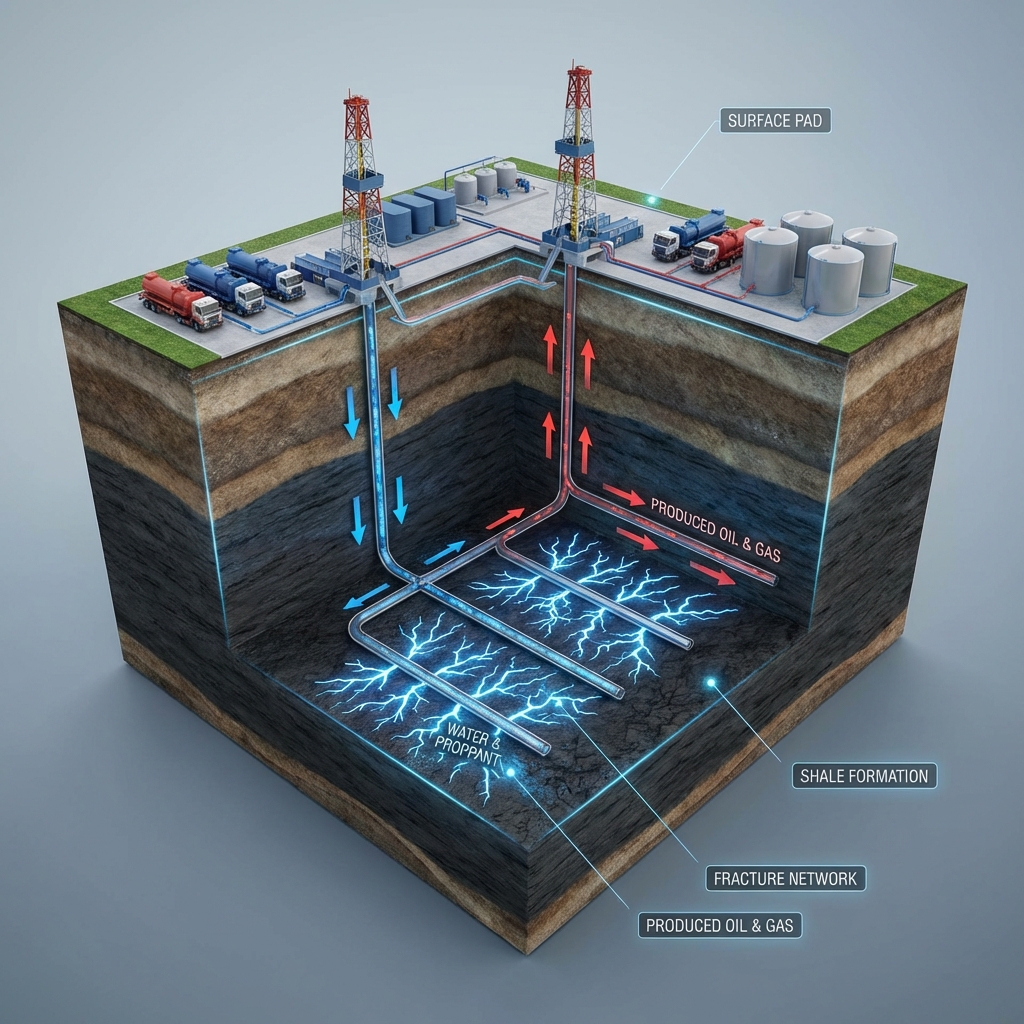 Figure 1: Technical illustration of a multi-well pad utilizing horizontal drilling and hydraulic fracturing to extract hydrocarbons from deep shale layers.
This process has turned "unconventional" resources into the primary driver of U.S. growth. The speed at which shale wells can be drilled and completed allows American producers to respond rapidly to global price signals, acting as the world's "Short-Cycle" swing producer.
Geology of the Super-Basins
The U.S. hydrocarbon wealth is distributed across several massive geological provinces, each with its own technical challenges and characteristics.
The Permian Basin: The Crown Jewel
The Permian Basin, stretching across West Texas and Southeastern New Mexico, is the engine of the U.S. energy boom. It is a "Super-Basin" with multiple stacked layers of productive rock, allowing operators to drill thousands of wells from a single location targeting different intervals.
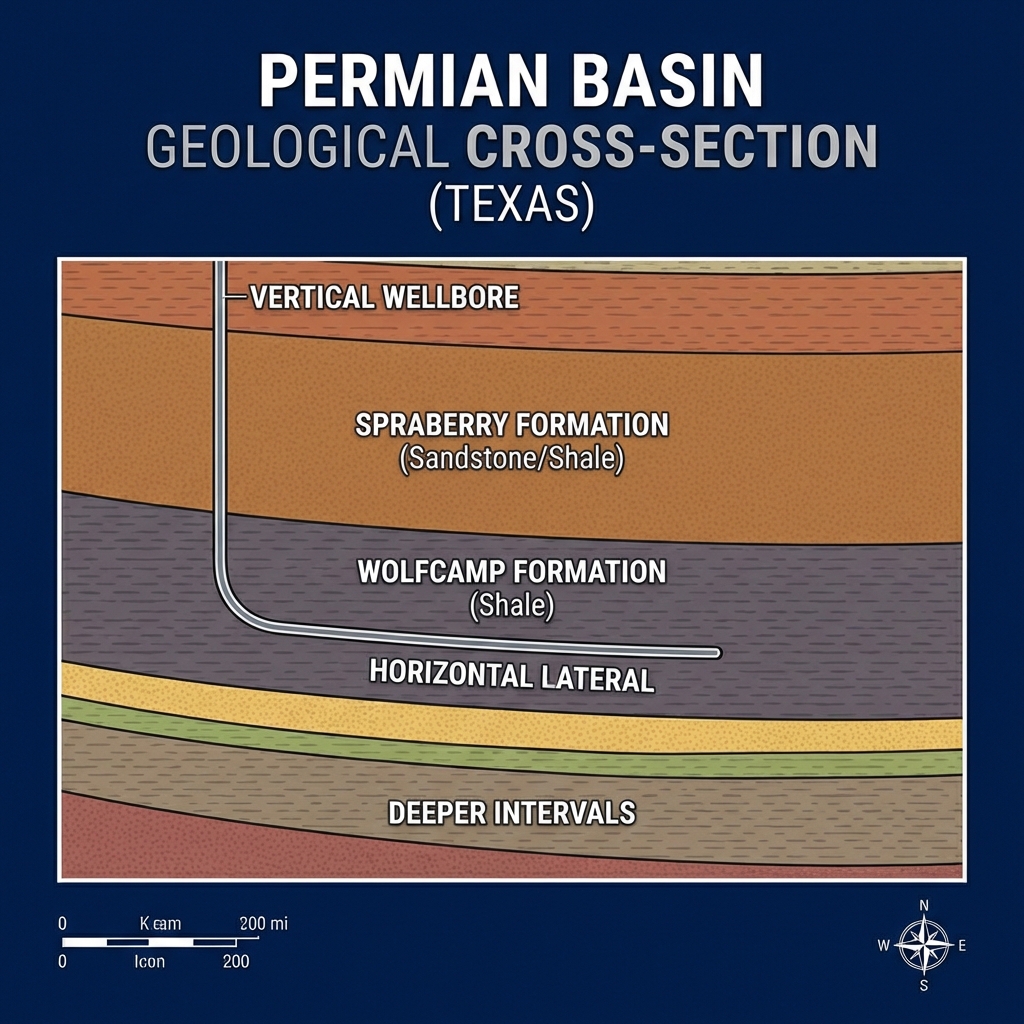 Figure 2: Geological cross-section of the Permian Basin showing the stacked Spraberry and Wolfcamp formations, which allow for high-efficiency production across multiple vertical intervals.
| Basin Name | Primary State(s) | Type | Key Significance |
|---|---|---|---|
| Permian | TX, NM | Shale / Stacked | Most productive basin in the world |
| Bakken | ND, MT | Shale Oil | Revitalized northern U.S. production |
| Eagle Ford | TX | Shale / Condensate | Strategic proximity to Gulf Coast export hubs |
| Marcellus | PA, WV | Shale Gas | Largest gas field in the United States |
| Gulf of Mexico | Offshore | Deepwater | High-volume, low-decline conventional base |
| Alaska North Slope | AK | Conventional | Strategic Arctic reserve / TAPS pipeline |
Infrastructure: The Arteries of Energy
To move millions of barrels of oil and billions of cubic feet of gas from remote basins to consumers and export terminals, the U.S. utilizes the most complex infrastructure network on Earth.
PADD Districts and Refining Clusters
The U.S. is divided into five Petroleum Administration for Defense Districts (PADD). The Gulf Coast (PADD 3) is the heart of the industry, home to over 50% of the nation's refining capacity and the world's most complex refining clusters, capable of processing every grade of crude from heavy Canadian bitumen to light Permian shale oil.
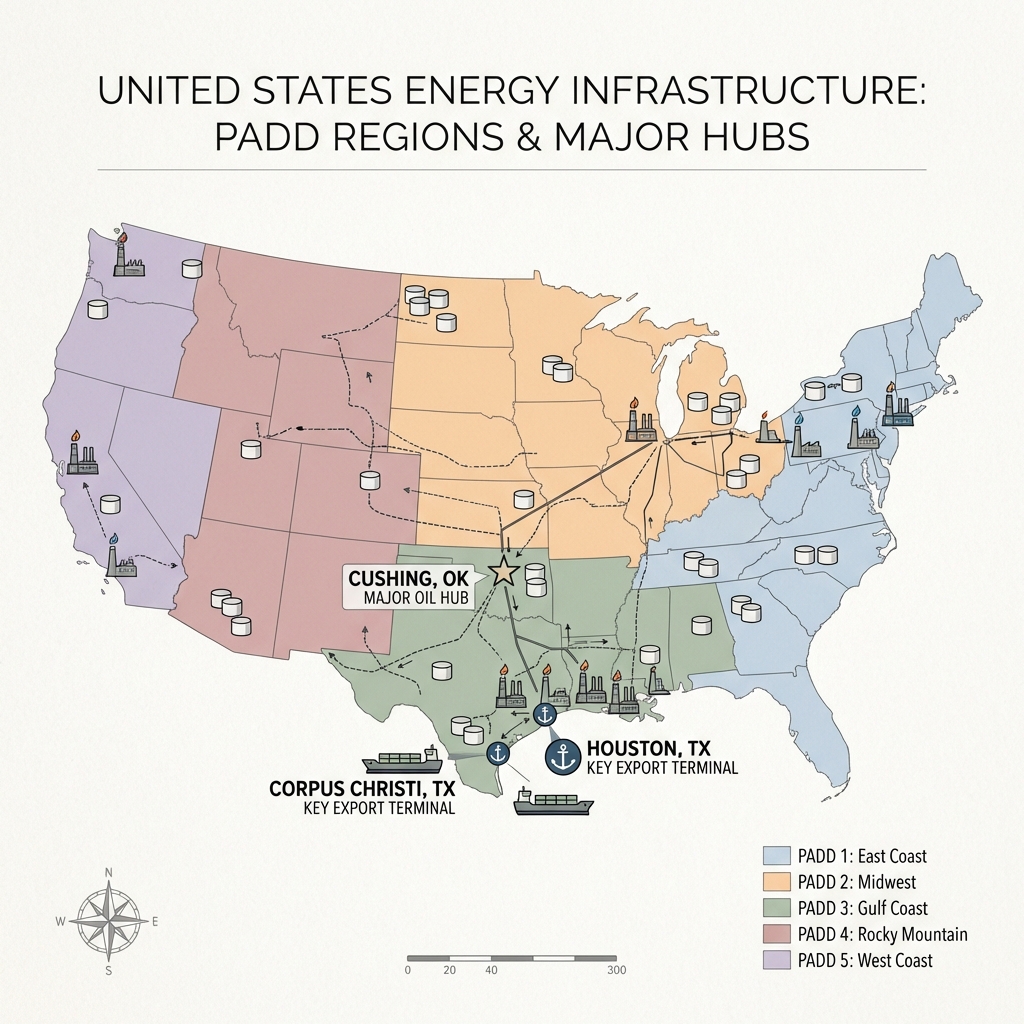 Figure 3: Overview of the US PADD regions and major infrastructure hubs, including the critical Cushing, OK storage hub and Gulf Coast export terminals.
The Strategic Petroleum Reserve (SPR)
The SPR, established in the 1970s, consists of four major salt cavern sites in Texas and Louisiana. With a capacity of over 700 million barrels, it serves as the ultimate insurance policy against global supply disruptions, ensuring that the American economy can withstand short-term shocks to the global energy market.
Discovery History: From Titusville to Fracking
The American oil story began in Titusville, Pennsylvania, in 1859, where Edwin Drake struck oil at 69 feet. This event triggered the "Pennsylvania Oil Rush" and led to the creation of Standard Oil by John D. Rockefeller, which consolidated and modernized the industry. For much of the 20th century, the U.S. was self-sufficient, but following the "Hubbert's Peak" in 1970, production entered a 35-year decline.
The narrative changed definitively in 2008. As oil prices reached record highs, the "shale boom" exploded. By 2018, the U.S. had surpassed Saudi Arabia and Russia to resume its position as the world's top producer. This second "Golden Age" of American oil is defined by data-driven precision, with AI and real-time sensor data now guiding the placement of every drill bit.
Technical Spotlight: The Digital Oilfield & AI in Shale
The second phase of the Shale Revolution is not being driven by steel and water, but by Data and Algorithms. The "Digital Oilfield" refers to the integration of cloud computing, edge sensors, and artificial intelligence into every stage of the upstream lifecycle.
Precision Drilling & Lateral Placement
In the Permian Basin, operators now use Managed Pressure Drilling (MPD) and AI-guided geosteering to keep the drill bit within the "primary pay zone"—a narrow window of shale often less than 15 feet thick—for lateral distances exceeding 3 miles. These AI systems analyze seismic data and real-time gamma-ray readings to adjust the bit's trajectory in microseconds, ensuring maximum contact with the most productive rock.
Predictive Maintenance & Logistical AI
On the surface, AI models predict equipment failures before they happen. By monitoring the vibration and heat signatures of fracking pumps, companies can schedule maintenance during planned downtime, avoiding "NPT" (Non-Productive Time) which can cost over $50,000 per hour. Furthermore, autonomous water-hauling trucks and AI-optimized sand logistics have reduced the breakeven cost of shale wells by an additional 15% since 2020.
Case Study: The 1970 Production Peak & The Hubbert Curve
For decades, the United States served as the cautionary tale of "Peak Oil." In 1956, geophysicist M. King Hubbert famously predicted that U.S. oil production would peak between 1965 and 1971 and then enter a permanent decline.
The Accuracy of the Prediction
Hubbert was remarkably accurate for conventional oil. U.S. production did indeed peak in 1970 at approximately 9.6 mb/d and entered a 35-year slide that reached a low of 5.0 mb/d in 2008. This decline led to the creation of the Department of Energy, the Strategic Petroleum Reserve, and the deep involvement of the U.S. military in Middle Eastern energy security.
Challenging the Theory
However, Hubbert did not account for Technological Disruption. The advent of shale technology essentially "reset" the Hubbert Curve. By 2018, the U.S. had surpassed its 1970 peak, reaching 12 mb/d, proving that "Peak Oil" is often a function of technology and investment rather than physical depletion. This history serves as a vital lesson for energy planners: resource scarcity is frequently a temporary state that can be resolved through innovation.
The Strategic Hub of Cushing, Oklahoma: The World's Pipeline Crossroads
Known as the "Pipeline Crossroads of the World," Cushing, Oklahoma, is the most important physical trading hub in the global oil market. Every barrel of West Texas Intermediate (WTI) crude—the primary global benchmark—is priced based on the delivery and storage levels in this town of just 8,000 people.
Massive Storage Capacity
Cushing serves as the primary "surge tank" for the U.S. pipeline network. It has a working storage capacity of over 90 million barrels, spread across hundreds of massive steel tanks. This storage allow producers and refiners to manage the mismatch between daily production and refinery throughput. When Cushing inventories are low, WTI prices often spike; when they are high, as seen during the 2020 price collapse, prices can drop into negative territory as storage space becomes a premium commodity.
The Interconnecting Network
Cushing is the junction where major pipelines from the Permian Basin, the Bakken, and the Canadian Oil Sands meet. It connects northern supply to the massive refining clusters on the Gulf Coast via pipelines like the Seaway and the Enterprise Echo. The technical management of this hub—balancing thousands of different crude grades and ensuring seamless transfer between competing pipeline operators—is one of the most complex logistical tasks in the global energy industry.
Technical Data: Major U.S. Shale Play Characteristics
To understand the complexity of the U.S. energy landscape, one must look at the specific technical characteristics of the primary shale plays. These plays differ significantly in their depth, thickness, and "thermal maturity" (whether they produce oil, dry gas, or wet gas).
| Play Name | Basin | Depth (ft) | Typical Thickness (ft) | API Gravity | Primary Hydrocarbon |
|---|---|---|---|---|---|
| Wolfcamp | Permian | 7,000 - 12,000 | 200 - 800 | 38° - 45° | Light Oil |
| Bone Spring | Permian | 6,000 - 11,000 | 1,500 - 3,500 | 40° - 46° | Light Oil |
| Bakken | Williston | 8,000 - 11,000 | 10 - 140 | 36° - 44° | Light Oil |
| Eagle Ford | Gulf Coast | 4,000 - 14,000 | 50 - 300 | 45° - 60° | Condensate / Oil |
| Marcellus | Appalachian | 4,000 - 8,500 | 50 - 200 | N/A | Dry Gas |
| Haynesville | Gulf Coast | 10,500 - 13,500 | 200 - 300 | N/A | High-Pressure Gas |
Analysis of Play Diversity
The vertical depth of the Haynesville makes it one of the most expensive plays to drill, but its high pressure results in massive initial production rates. In contrast, the Wolfcamp in the Permian is favored for its "stacked pay" potential, where a single surface location can access up to four distinct productive horizontal layers. The high API gravity of the Eagle Ford makes it a preferred feedstock for Gulf Coast refineries looking to produce high-value petrochemicals and jet fuel.
Regulatory & Tax Framework: A Dual-Track System
The U.S. oil and gas industry operates under a complex "Dualways" regulatory system that distinguishes between federal and private (state) lands.
Federal vs. Private Mineral Rights
Unlike most nations where the state owns all sub-surface resources, the U.S. allows for private ownership of mineral rights. This has been a primary driver of the shale boom, as small independent operators can quickly lease land from private owners without the need for federal approval. On federal lands and in the outer continental shelf (OCS), operations are overseen by the Bureau of Land Management (BLM) and the Bureau of Ocean Energy Management (BOEM), involving rigorous environmental impact studies and competitive bidding auctions.
The Depletion Allowance & Intangible Drilling Costs (IDCs)
The U.S. tax code provides significant incentives for domestic production, most notably the Depletion Allowance, which allows producers to account for the reduction in value as oil is extracted. Additionally, the ability to immediately deduct Intangible Drilling Costs (IDCs)—such as labor, fuel, and supplies—allows independent producers to reinvest capital more quickly into new wells, maintaining the rapid drilling pace characteristic of the shale industry.
Geopolitical Strategy: From Scarcity to Dominance
The shift from an importer to an exporter has fundamentally changed U.S. foreign policy.
- Energy Independence: For the first time in decades, the U.S. is no longer vulnerable to "Oil Weapons" or embargoes from hostile regions.
- The LNG Bridge: American Liquefied Natural Gas (LNG) has become the primary alternative to Russian gas for Europe, acting as a vital stabilizer during the 2022 energy crisis.
- Benchmark Pricing: The WTI (West Texas Intermediate) benchmark, traded in Cushing, OK, remains the world's most transparent and liquid oil price marker, reflecting the health of the global economy.
The Energy Transition: Net Zero Ambitions
Despite its status as a fossil fuel giant, the U.S. is leading the way in "Decarbonizing Oil."
- CCUS: The U.S. has the world's most advanced Carbon Capture, Utilization, and Storage infrastructure, with the 45Q tax credit incentivizing producers to sequester CO2.
- Blue Hydrogen: Leveraging methane reserves, American producers are building the world's first industrial-scale blue hydrogen hubs.
- Electrification: Oil producers in the Permian are increasingly powering their rigs and equipment with solar and wind to reduce the carbon intensity of every barrel produced.
Future Outlook: The Sustainability Frontier
The future of American energy is defined by Capital Discipline and Sustainability. The industry has moved from "Growth at all Costs" to a model focused on returning value to shareholders and minimizing environmental footprints. As the world navigates the 21st-century energy transition, the United States aims to be the "Last, Cleanest Producer," providing the essential energy needed for global stability while pioneering the zero-carbon technologies of tomorrow.

"PetroEyes Research is the site-level attribution used for public data summaries and explainers. It does not represent a licensed financial adviser or a fictional individual. Articles remain outside public discovery until their named sources, dates, and material claims complete editorial review."